
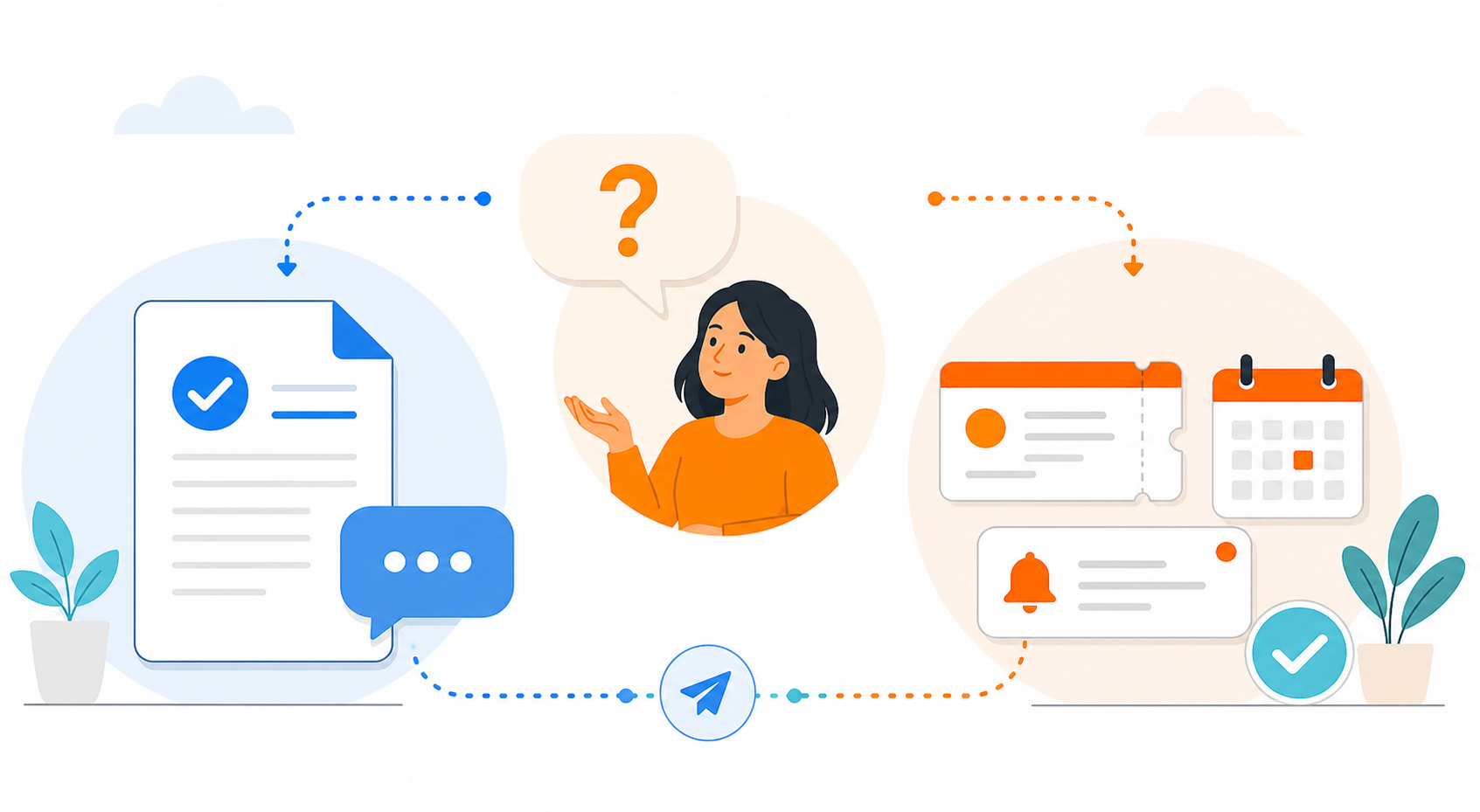
Your Amazon Connect Platform Changed in 2026. Did Anyone Tell You?

Your Amazon Connect Platform Changed in 2026. Did Anyone Tell You?

At the beginning of 2026, AWS began rolling out a remarkable range of new Amazon Connect capabilities. Existing contact centers can now take advantage of AI-powered customer self-service, real-time agent assistance, automated summaries, improved analytics, AI performance evaluation, and AI agents that can retrieve information and complete approved actions.

Here is the surprising part: DrVoIP has built more than one hundred Amazon Connect platforms over the last several years, yet we have received almost no requests from existing customers asking how these new AI capabilities might improve their contact centers.

That does not mean there are no useful opportunities. It suggests that many organizations simply do not know what has changed—or assume that adding AI requires replacing the contact center they already have.

It does not.

Your Amazon Connect instance may be more capable than when it was deployed

Amazon Connect is no longer just a cloud-based replacement for a traditional telephone system or automatic call distributor. AWS now describes its next-generation platform as an AI-native customer-experience solution supporting human agents, AI-assisted agents, and autonomous AI agents.

Depending on the AWS Region, instance configuration, licensing, and features enabled, organizations may now be able to use Amazon Connect for:

  • Agentic customer self-service across voice and chat
  • Real-time answers and next-best-action recommendations for human agents
  • Post-contact summaries and automated note-taking
  • AI-generated email overviews and suggested responses
  • Conversational analytics across voice, chat, messaging, and email
  • AI-assisted case summaries
  • Quality evaluations for human-agent and AI-agent interactions
  • Customer-first callbacks
  • Forecasting, capacity planning, and agent scheduling
  • AI performance metrics, including goal completion and tool-selection accuracy

AWS continues to add capabilities throughout the year. Its Amazon Connect release notes document changes almost every month.

These features are not necessarily activated merely because they exist. Some require an instance update, feature enablement, new security permissions, additional configuration, supported Regions, or commercial consideration. More importantly, they require someone to determine how they should fit into the customer journey.

The word “agent” no longer means only a person

Contact-center terminology has become confusing. An agent has traditionally meant the person answering a call. Amazon Connect also uses the term AI agent for a configured artificial-intelligence capability that can assist an employee or interact directly with a customer.

The newer agentic self-service model is much more than a scripted chatbot. According to the current AWS self-service documentation, an Amazon Connect AI agent can reason across multiple steps, maintain a continuous conversation, invoke approved tools, complete work, and escalate to a human agent when necessary.

That distinction matters.

A conventional bot might identify an intent, collect an account number, and return control to a contact flow. An agentic system can potentially understand the goal, decide which approved step comes next, retrieve the necessary information, use an authorized tool, and continue the conversation until the request is completed or human assistance is required.

AI for Answers and AI for Action

At DrVoIP, we organize these opportunities into two practical categories.

AI for Answers

AI for Answers helps customers and employees find, understand, and summarize trusted information.

Examples include:

  • Answering questions from an approved knowledge base
  • Helping an agent locate a policy during a live call
  • Summarizing the customer’s previous interactions
  • Creating a concise post-call summary
  • Suggesting an appropriate email response
  • Explaining a product, procedure, or account requirement

The AI provides information, but a customer or employee generally decides what happens next.

AI for Action

AI for Action connects the conversation to an operational result.

Examples include:

  • Looking up an order or appointment
  • Creating a support case
  • Rescheduling a service visit
  • Updating an approved customer record
  • Initiating a refund under defined business rules
  • Sending a confirmation or notification
  • Escalating an urgent request with the collected context intact

Amazon Connect now supports the Model Context Protocol, commonly called MCP. This allows properly configured AI agents to use standardized tools for retrieving information and completing actions. AWS provides more detail in its AI-agent MCP tools documentation.

This is where conversational AI becomes especially valuable. The goal is no longer merely to make a bot sound more human. The goal is to help the customer accomplish something.

Agentic does not mean unlimited autonomy

An AI agent should not receive unrestricted access to every system simply because it can use tools.

A production design must determine:

  • Which knowledge sources the AI agent may use
  • Which customer information it may retrieve
  • Which tools it is permitted to invoke
  • Which records it may update
  • Which actions require customer confirmation
  • Which actions require employee approval
  • When the interaction must be transferred to a person
  • What information must accompany that transfer
  • What activity must be logged for auditing and review

Amazon Connect security profiles help define the resources and tools available to an AI agent. Amazon Bedrock guardrails can help filter harmful content, protect sensitive information, and enforce selected response boundaries. AWS explains these controls in its AI guardrail documentation.

Guardrails, however, are only one layer. Authentication, permissions, transaction limits, confirmations, monitoring, failure handling, human escalation, and rollback procedures remain part of the overall solution.

Where should an existing contact center begin?

Do not begin by asking, “Where can we install AI?”

Begin with a customer or agent problem:

  • Which questions repeatedly consume agent time?
  • Why are customers transferred?
  • Which after-hours requests could be completed safely?
  • Which parts of after-contact work are repetitive?
  • Where do agents search multiple systems for an answer?
  • Which callbacks or follow-up tasks are frequently missed?
  • Which self-service experiences currently trap or frustrate customers?

Then select one bounded use case with reliable information, available system access, a clear completion state, and an easy route to a person.

A sensible first project might be an AI agent that answers a defined group of questions and transfers the full conversation context to a human when it cannot answer confidently. Another might allow authenticated customers to check an order or appointment and perform one carefully controlled action.

The first objective should not be maximum automation. It should be a measurable improvement that the organization can observe, govern, and support.

Your existing contact center deserves a 2026 review

If your Amazon Connect platform was designed in 2023, 2024, or even 2025, it was built around the capabilities and business requirements available at that time. The platform may still be working exactly as designed—but the range of choices has changed substantially.

A 2026 review does not have to become a major migration project. It can begin with a focused conversation:

  • Which new capabilities are available in the deployed Region and instance?
  • Which features need to be enabled or licensed?
  • Which existing flows and integrations are good candidates for improvement?
  • Where could AI for Answers reduce customer or agent effort?
  • Where could AI for Action safely complete useful work?
  • What security, knowledge, testing, and operational preparation would be required?

DrVoIP brings an unusual perspective to this discussion. We are telecommunications and contact-center engineers first. We understand queues, routing, voice, WebRTC, customer journeys, integrations, and the operational realities of a live call center. We then apply AI where it makes the experience or outcome better.

If we built your Amazon Connect platform—or if someone else did—this is a good time to look again at what it can become.

Would you like to identify one practical AI for Answers or AI for Action opportunity in your current Amazon Connect environment?

Contact DrVoIP or call to begin the conversation.
AWS Bedrock, LangGraph, or CrewAI? Choosing an AI Stack That Survives Production

Executive summary: Amazon Bedrock, LangGraph, and CrewAI are not three competing versions of the same product. Amazon Bedrock supplies managed access to AI models and supporting services. Frameworks such as Strands Agents, LangGraph, and CrewAI determine how an AI application reasons, collaborates, uses tools, and moves through a process. Amazon Bedrock AgentCore can then provide the managed runtime and operational infrastructure needed to take many of those applications into production.

The right question is therefore not, “Which tool wins?” It is, “Which combination gives the business the control, security, recoverability, and accountability it will need after the demonstration is over?”

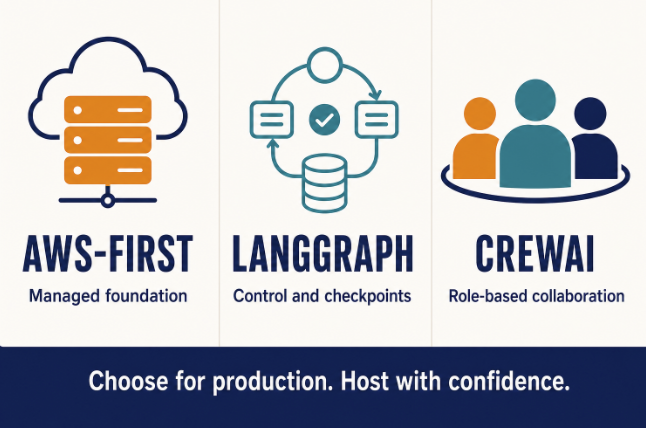
Business leaders evaluating three production AI implementation paths on a common managed platform
Production AI is usually a stack of complementary services—not a winner-take-all tool selection.

The Demo Is Not the Difficult Part

Building an AI demonstration has become remarkably fast. A small team can connect a model, add a few documents, call an external service, and produce something impressive before the coffee gets cold.

Production is where the adult questions arrive:

  • Who is allowed to ask the system to take an action?
  • Which customer or employee data can it access?
  • What happens when an external system is unavailable?
  • Can a transaction be resumed without starting over?
  • Which decisions require human approval?
  • Can the business explain what happened after an error?
  • How will quality, safety, latency, and cost be measured?
  • Who receives the 2:00 a.m. phone call?

That last question has ended more architectural debates than any benchmark ever will.

Start by Separating the Layers

Much of the confusion disappears when the technology is divided into layers.

1. Models and managed AI services

Amazon Bedrock provides managed access to foundation models and related capabilities such as knowledge bases and guardrails. It is the part of the stack that gives an organization governed access to AI models without operating the underlying model infrastructure.

Bedrock is therefore not a direct one-for-one replacement for LangGraph or CrewAI. Those products operate primarily at the application and orchestration layer.

2. Agent logic and orchestration

This layer determines how the application divides work, selects tools, maintains state, applies business rules, and involves people.

  • Strands Agents is an attractive AWS-first framework with agent, graph, workflow, and multi-agent patterns.
  • LangGraph is particularly strong when the process needs explicit states, checkpoints, controlled transitions, recovery, and human approvals.
  • CrewAI is appealing when the business problem is naturally described as a group of specialists working together toward an outcome.
  • Other frameworks or custom code may be appropriate when an organization already has established skills, intellectual property, integrations, or portability requirements.

3. Production runtime and agent infrastructure

Amazon Bedrock AgentCore is designed to provide managed production infrastructure for agents. Its capabilities include runtime, memory, identity, tool connectivity, observability, and evaluations.

Importantly, AgentCore is framework-agnostic. AWS documents support for agents built with Strands, LangGraph, CrewAI, Google ADK, the OpenAI Agents SDK, and custom implementations. In many architectures, AgentCore complements the selected framework instead of replacing it.

4. Deterministic business workflows

Not every business process should be placed under the control of an AI agent.

When a step must occur in an exact order, produce an auditable result, retry predictably, or follow a strict timeout, services such as AWS Step Functions and Amazon EventBridge are often better coordinators. The agent can contribute judgment where judgment is valuable while a deterministic workflow keeps control of the transaction.

In plain English: let AI interpret an unusual customer request; let conventional workflow automation make certain the refund is approved, recorded, and reconciled correctly.

When an AWS-First Stack Is the Sensible Default

An AWS-first design is compelling when the organization already operates primarily in AWS and wants to minimize the amount of infrastructure assembled from separate vendors.

A practical starting point is:

  • Models: Amazon Bedrock
  • Agent framework: Strands Agents
  • Runtime and agent infrastructure: Amazon Bedrock AgentCore
  • Retrieval: Bedrock Knowledge Bases, Amazon OpenSearch, or a specialized external data platform
  • Safety: Bedrock Guardrails
  • Identity: AWS Identity and Access Management together with AgentCore Identity
  • Monitoring and evaluation: AgentCore Observability and Evaluations, Amazon CloudWatch, and OpenTelemetry
  • Business workflow: Step Functions and EventBridge

This is not automatically the best design for every company. It is simply a coherent default: fewer operational seams, familiar security controls, consolidated accountability, and less infrastructure for the internal team to assemble.

It is the architectural equivalent of buying a coordinated kitchen rather than ordering the refrigerator, plumbing, cabinets, and electrical system from four companies that have never met.

When LangGraph Earns a Place

LangGraph deserves serious consideration when control over the execution path is central to the business requirement.

Examples include:

  • A transaction must pause for approval and resume later.
  • Every stage needs a durable checkpoint.
  • A failed step must be retried without repeating completed work.
  • The application requires explicit branches, loops, and exit conditions.
  • Operators need to inspect or alter state during execution.
  • The company wants detailed control over how long-running agent processes behave.

Consider a contract-review application. An AI model might identify unusual language, but legal approval must occur before the revised agreement is sent. The system may need to pause for two days and then resume from exactly the same point. That is the sort of requirement where durable state and human-in-the-loop controls matter far more than which framework produced the prettiest first demonstration.

LangGraph can still use models from Amazon Bedrock and can be deployed using AgentCore. Choosing LangGraph does not require abandoning an AWS-centered architecture.

When CrewAI Fits the Business Problem

CrewAI works well when business stakeholders already describe the process as a team of specialized roles.

For example, a marketing-content operation might include:

  • A research agent that gathers approved information
  • A product agent that verifies capabilities
  • A compliance agent that checks claims
  • An editor agent that assembles the final material
  • A supervisor that reviews whether the work is complete

That model is intuitive to business users because it resembles an organization. Roles, goals, tools, and assignments can be discussed without beginning the meeting with a diagram that looks like the New York subway map.

However, a good organizational metaphor does not eliminate production responsibilities. The implementation still needs identity, permissions, memory, data protection, evaluation, recovery, and monitoring. CrewAI can provide the collaboration pattern while AgentCore or another production platform supplies much of the operational foundation.

Comparison of AWS-first, LangGraph, and CrewAI production use cases
Choose the framework for the shape of the work, then choose the runtime and controls needed to operate it safely.

A Note About Amazon Bedrock Agents

AWS now refers to the earlier Amazon Bedrock Agents service as Amazon Bedrock Agents Classic. AWS documentation states that it is in maintenance mode and is not open to new customers. Existing customers can continue using it, but new designs should evaluate AgentCore and current AWS agent-building options before adopting an architecture centered on Agents Classic.

This is a useful reminder that production selection must account for product lifecycle as well as technical capability.

Use a Production Scorecard, Not a Demo Contest

Before selecting the stack, score each candidate against the following business requirements:

  • State: Can work pause, persist, and resume safely?
  • Security: Are identity, permissions, credentials, and data boundaries enforceable?
  • Recovery: What happens when a model, tool, or outside system fails?
  • Human control: Which decisions can be reviewed, edited, or rejected?
  • Evaluation: How will the company measure accuracy, safety, completion, and tool use?
  • Observability: Can operators trace what the system did and why?
  • Governance: Are changes reviewed, versioned, tested, and auditable?
  • Interoperability: Can models, tools, and data platforms be changed without rebuilding everything?
  • Cost: Can usage be attributed, forecast, limited, and explained?
  • Ownership: Does the company have—or can it obtain—the skills to operate the result?

The fastest demonstration may still win. It simply should not win by default.

The Practical Recommendation

For an organization already invested in AWS, begin by testing an AWS-first stack: Amazon Bedrock for models, Strands Agents for agent logic, AgentCore for the production runtime, and AWS workflow, identity, safety, and monitoring services around it.

Add LangGraph when durable execution, explicit state, or sophisticated approvals are defining requirements. Add CrewAI when role-based collaboration is the clearest and most maintainable representation of the work. Consider other frameworks when existing expertise, portability, specialized integrations, or product strategy justify them.

Most importantly, do not ask one tool to solve every layer. A model platform, an agent framework, and a production runtime have different jobs. The strongest implementation is often a thoughtfully governed combination.

DrVoIP can help your organization turn an AI use case into a production architecture—before a promising demonstration becomes an expensive collection of assumptions. Contact us to arrange an AI production-readiness and architecture review.

Further Reading